
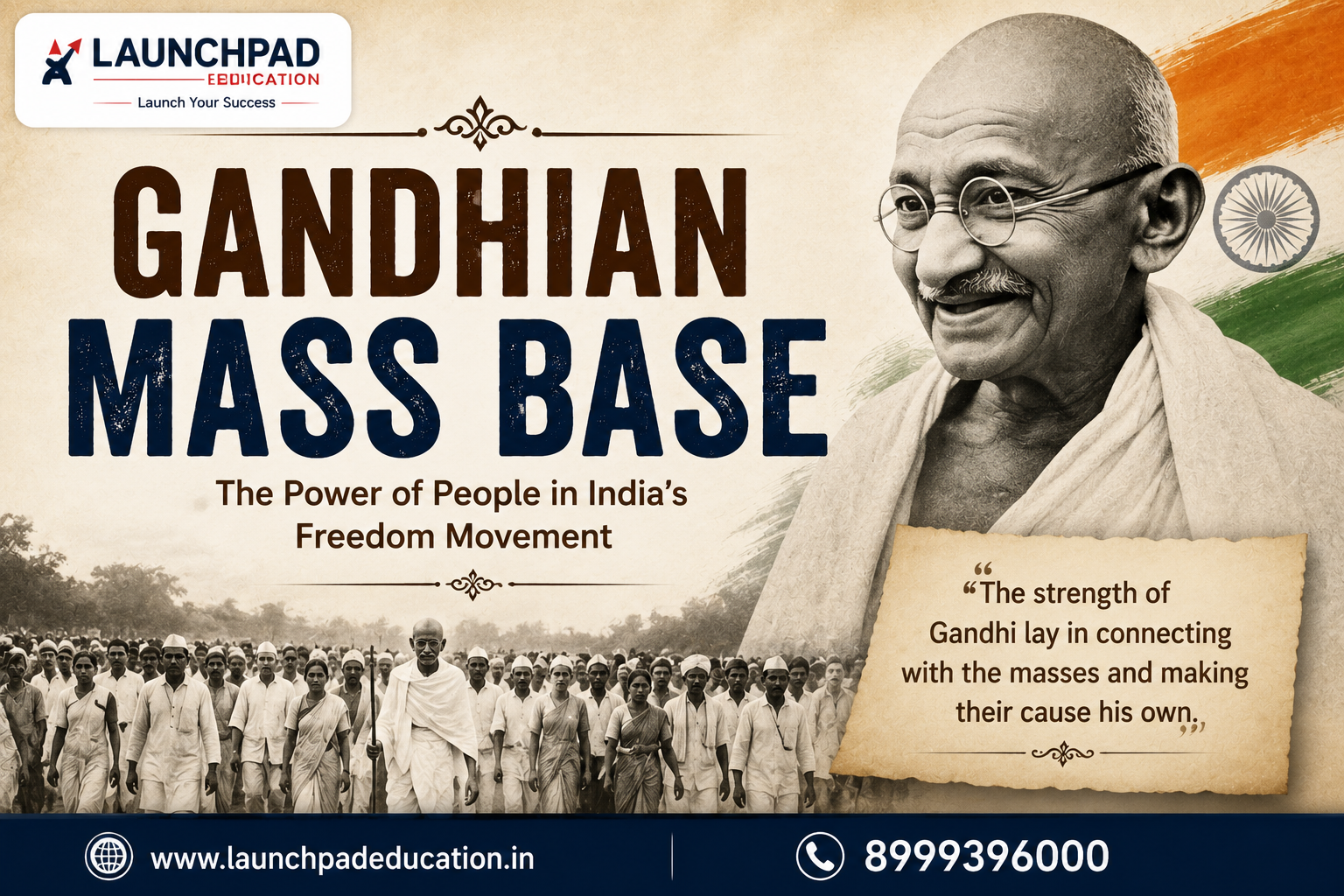
Gandhi’s greatest contribution to the Indian national movement was not merely a series of movements, but the transformation of nationalism into a genuine mass movement. Before Gandhi, nationalism largely remained confined to educated elites and urban political circles. Gandhi brought peasants, workers, women, students, traders and sections of the middle class into active participation.
How Gandhi Built a Mass Base
1. Appeal to the Peasantry:
Gandhi connected nationalism with the everyday problems of peasants—land revenue, indigo cultivation, forced labour, rents and indebtedness. Champaran, Kheda and later the Bardoli movement demonstrated how local grievances could be linked with the wider struggle against colonial rule.
2. Participation of the Urban Middle Class:
Lawyers, teachers, students, professionals and small traders became important organisers and supporters of the national movement. Gandhi’s emphasis on boycott, swadeshi and constructive work provided them with accessible forms of political participation.
3. Role of Women:
Gandhian politics opened unprecedented space for women in public life. Participation in picketing, boycott, spinning, salt satyagraha and civil disobedience allowed women to enter nationalist politics on a large scale.
4. Workers and Labour:
Although Gandhi maintained a cautious approach towards class conflict, his movements also attracted sections of industrial workers. His method emphasised non-violence, negotiation and moral pressure rather than revolutionary class confrontation.
5. Religious and Cultural Symbols:
Gandhi used symbols familiar to ordinary Indians—khadi, charkha, fasting, satyagraha and simple living. This gave nationalism a form that could be understood beyond the educated elite.
6. Constructive Programme:
For Gandhi, nationalism did not begin and end with protests against the British. Khadi, removal of untouchability, Hindu-Muslim unity, village uplift and basic education were intended to make nationalism part of everyday social life.
Why Was Gandhi So Successful?
The key was political simplification. Gandhi converted complicated constitutional questions into issues that ordinary people could understand and participate in.
For an ordinary Indian, nationalism was no longer merely about councils, petitions or constitutional reforms. It became something as tangible as wearing khadi, refusing foreign cloth, making salt, joining a hartal or refusing cooperation with colonial institutions.
A Critical Perspective
Gandhi’s mass base was broad but not uniform. Different groups entered the national movement with different expectations. Peasants sought relief from agrarian oppression; workers looked for better conditions; business groups wanted protection from colonial economic policies; women sought greater public participation; and the Congress sought national independence.
Therefore, Gandhian nationalism was a coalition of diverse social interests, held together primarily by the idea of anti-colonial struggle.
UPSC Perspective
Gandhi did not simply mobilise the masses; he changed the character of Indian nationalism itself.
Elite nationalism → Mass nationalism
Petitions → Satyagraha
Political centres → Villages and towns
Limited participation → Wider social participation
Abstract nationalism → Everyday nationalism
Conclusion
Gandhi’s mass base rested on his ability to connect the national struggle with ordinary people’s lived experiences. His greatest political achievement was making the freedom struggle something in which the common Indian could see both a national purpose and a personal stake.
UPSC one-liner:
Gandhi transformed Indian nationalism from an elite political discourse into a broad-based mass movement by combining local grievances, simple symbols, non-violent action and constructive social programmes.
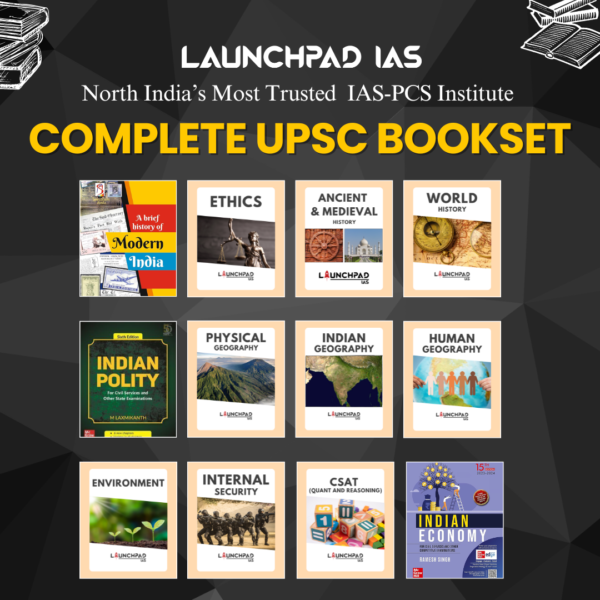
Complete UPSC Bookset
UPSC Bookset
Our UPSC Bookset is designed to help you prepare effectively for the IAS-IPS exams. It includes comprehensive study materials and practice resources tailored to cover the entire syllabus.
Features:
- Complete Coverage: All essential subjects and topics included.
- Latest Edition: Updated with the most recent exam patterns and guidelines.
- Easy to Understand: Simplified explanations and clear diagrams.
- Practice Questions: A wide range of practice questions to test your knowledge.
List of Books:
- Indian Polity (Laxmikant)
- Indian Economy (Ramesh Singh)
- Modern History (Spectrum)
- LaunchPad CSAT Book
- LaunchPad Environment Book
- LaunchPad Ancient & Medieval History Book
- LaunchPad World History Book
- LaunchPad Internal Security Book
- LaunchPad Ethics Book
- LaunchPad Physical Geography
- LaunchPad Human Geography Book
- LaunchPad Indian Geography
- Digital Notes & Ncert PDFS