
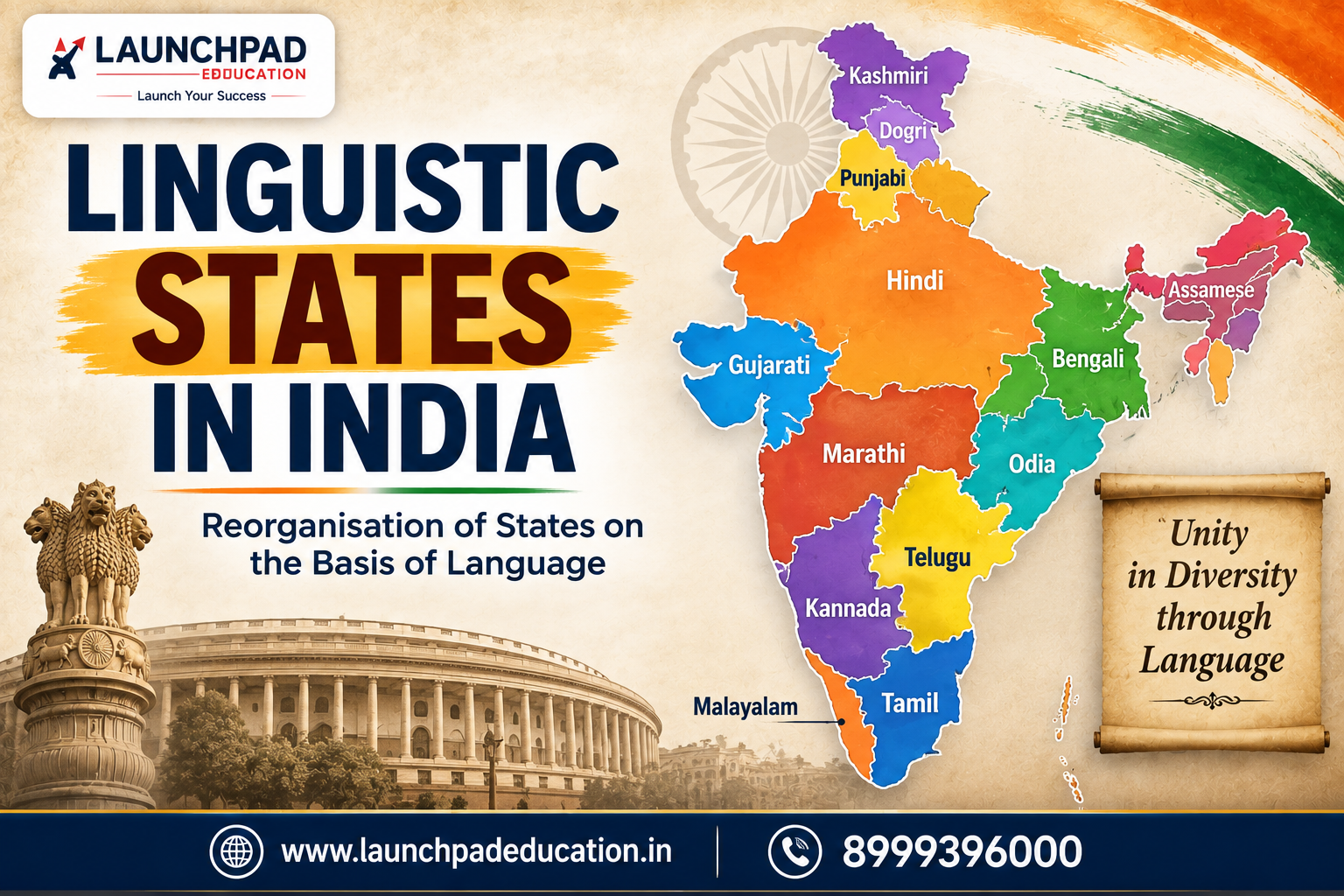
The reorganisation of Indian states on a linguistic basis was one of the most important challenges faced by independent India. At the time of Independence, India inherited a complex administrative map consisting of provinces, princely states and various centrally administered territories. The question was whether states should be reorganised according to language, administrative convenience, economic viability or national unity.
The linguistic reorganisation of states ultimately demonstrated that accommodating regional identities within a constitutional framework could strengthen, rather than weaken, Indian unity.
Why Did the Demand for Linguistic States Arise?
Language was closely connected with people’s culture, literature, history and regional identity. During British rule, several administrative provinces contained populations speaking different languages.
After Independence, people increasingly demanded states where administration could be conducted in their own language.
The demand was therefore not merely linguistic. It also represented aspirations for political participation, cultural recognition and administrative accessibility.
Early Congress Position
The idea of linguistic provinces was not new.
The Indian National Congress had recognised linguistic identities even before Independence. In 1920, the Congress reorganised its provincial committees largely along linguistic lines.
However, after Independence, the leadership became cautious.
The immediate priorities were national integration, refugee rehabilitation, economic reconstruction and the integration of princely states. There was concern that linguistic reorganisation could encourage regionalism and weaken national unity.
Dhar Commission, 1948
The Government of India appointed the Dhar Commission in 1948, headed by S. K. Dhar, to examine the question of linguistic provinces.
The Commission did not favour linguistic reorganisation as the primary basis for creating states.
It emphasised factors such as:
– Administrative convenience
– Financial viability
– National interests
Thus, language alone was considered insufficient for immediate reorganisation.
JVP Committee, 1948–49
Following the Dhar Commission, the JVP Committee was formed.
It consisted of:
Jawaharlal Nehru + Vallabhbhai Patel + Pattabhi Sitaramayya
The committee also advised caution regarding linguistic states.
However, it recognised that the issue could not be ignored indefinitely and that public sentiment would have to be considered.
The Turning Point: Potti Sriramulu
The movement for a separate Telugu-speaking state became the turning point.
Potti Sriramulu, a prominent Gandhian, undertook a prolonged fast demanding a separate state for Telugu-speaking people.
His death in December 1952 triggered widespread protests in the Telugu-speaking regions.
The intensity of the movement compelled the government to reconsider its position.
Creation of Andhra State, 1953
In 1953, the first major linguistic state of independent India was created:
Andhra State
It was carved out of the Madras State for Telugu-speaking people.
This development created pressure for a comprehensive examination of the entire territorial structure of India.
States Reorganisation Commission, 1953
The Government appointed the States Reorganisation Commission (SRC) in 1953.
It was headed by:
🔹 Fazl Ali — Chairman
🔹 K. M. Panikkar — Member
🔹 H. N. Kunzru — Member
The Commission submitted its report in 1955.
Importantly, it did not recommend language as the sole criterion. Instead, it proposed a balanced approach considering:
Language + culture + administrative convenience + economic viability + national unity.
States Reorganisation Act, 1956
The recommendations resulted in the States Reorganisation Act, 1956.
The Act came into effect on 1 November 1956 and significantly redrew India’s internal boundaries.
The Seventh Constitutional Amendment Act, 1956 accompanied this reorganisation.
The earlier classification of states into Part A, Part B, Part C and Part D was abolished.
India was reorganised into 14 states and 6 Union Territories.
Important Linguistic States After 1956
The process did not end in 1956.
Several new states were subsequently created or reorganised:
🔹 Maharashtra & Gujarat — 1960
🔹 Nagaland — 1963
🔹 Punjab, Haryana & Himachal Pradesh reorganisation — 1966
🔹 Meghalaya — 1972
🔹 Manipur & Tripura attained statehood — 1972
🔹 Mizoram & Arunachal Pradesh — 1987
🔹 Chhattisgarh, Uttarakhand & Jharkhand — 2000
🔹 Telangana — 2014
These developments show that India’s territorial reorganisation has been an ongoing constitutional process, rather than a one-time event.
Linguistic Reorganisation: Threat or Strength?
Initially, many national leaders feared that linguistic states might encourage regionalism and separatism.
In practice, however, linguistic recognition largely helped integrate regional aspirations into the constitutional system.
People could preserve their language and cultural identity while remaining part of the Indian Union.
Thus, linguistic reorganisation can be understood as an example of India’s broader strategy of “unity in diversity.”
Constitutional Provisions
The Constitution provides Parliament with considerable power over the territorial organisation of India.
Article 3
Parliament can:
– Form a new state
– Increase or diminish the area of a state
– Alter state boundaries
– Alter the name of a state
The President must refer such a Bill to the concerned State Legislature for expressing its views.
Important UPSC point: The views of the State Legislature are not binding on Parliament.
Article 4
Laws made under Articles 2 and 3 may amend the First and Fourth Schedules and are not treated as constitutional amendments under Article 368.
UPSC Perspective
For Prelims, remember the chronology:
1920 → Congress linguistic reorganisation
1948 → Dhar Commission
1948–49 → JVP Committee
1952 → Death of Potti Sriramulu
1953 → Andhra State
1953 → SRC appointed
1955 → SRC Report
1956 → States Reorganisation Act + 7th Amendment
For Mains, linguistic reorganisation can be used to illustrate how Indian federalism has accommodated regional aspirations without compromising national unity.
Conclusion
The creation of linguistic states was not simply an exercise in redrawing administrative boundaries. It was a crucial experiment in democratic accommodation.
Independent India chose neither to suppress linguistic identities nor to allow them to become forces of fragmentation. Instead, it incorporated them within the federal structure.
The experience of linguistic reorganisation therefore demonstrates an important feature of Indian democracy: national unity can be strengthened by recognising diversity rather than denying it.

UPSC CSE 2028 ONLINE
🚀 UPSC 2028 Online Foundation Course
A complete recorded foundation program for UPSC CSE 2028 aspirants. Get comprehensive GS coverage, Current Affairs classes, Answer Writing Guidance, Tests, Mentorship, and Doubt-Clearing Sessions. Access high-quality video lectures and PDF study material anytime, anywhere through the Launchpad IAS App.
🎯 Designed for beginners.
📚 Recorded Classes + PDF Notes.
🏆 Structured Preparation for UPSC CSE 2028.