
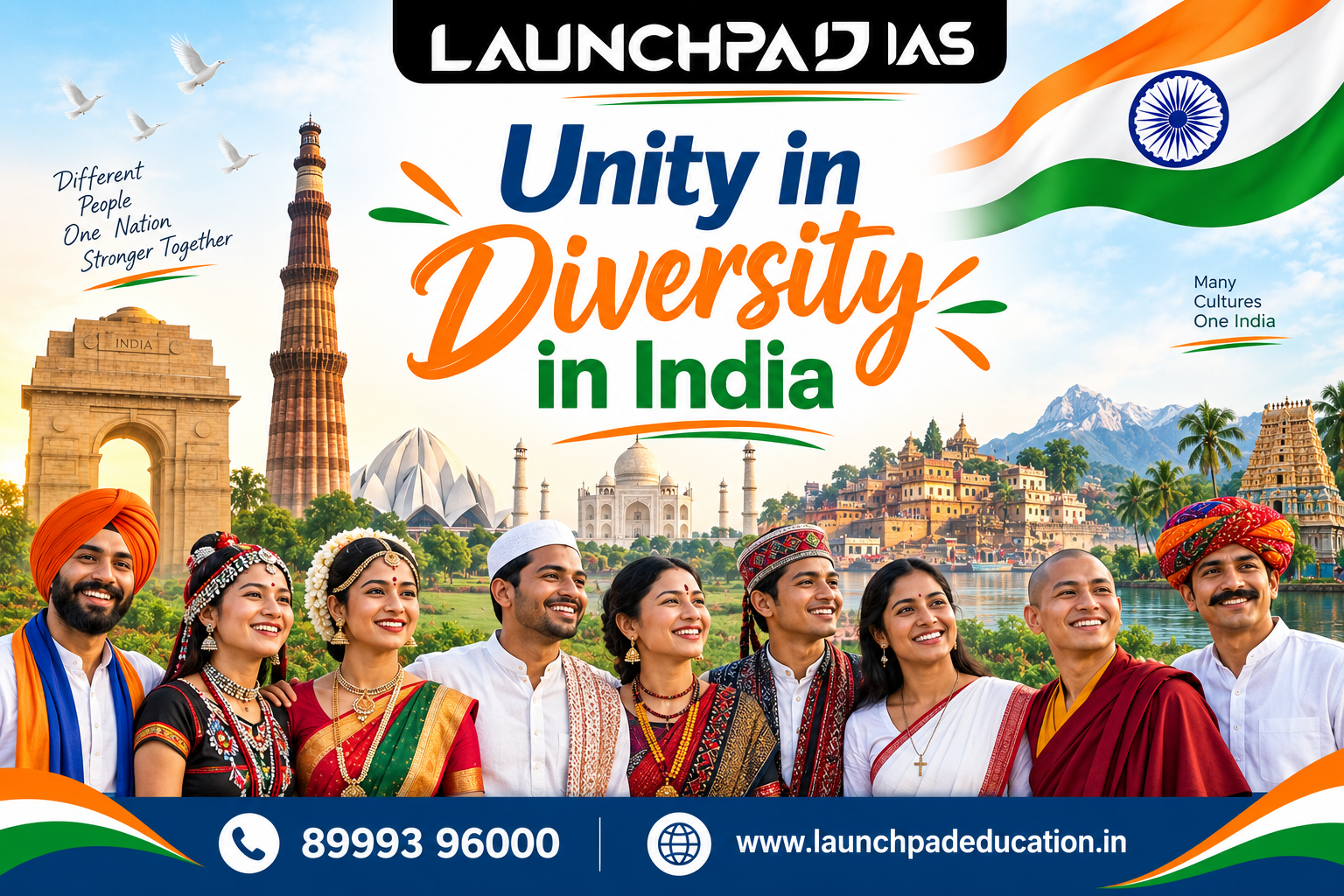
Introduction
India is characterised by extraordinary diversity in religion, language, ethnicity, caste, tribe, region, customs, traditions and lifestyles. Yet these differences coexist within a common constitutional, political and civilisational framework.
This phenomenon is commonly described as “Unity in Diversity”.
Unity in diversity does not mean uniformity. Rather, it represents the ability of different communities and identities to coexist while maintaining a broader sense of belonging to the Indian nation.
The resilience of Indian unity is therefore based on constitutional accommodation, cultural synthesis, democratic institutions, economic interdependence and everyday social interaction.
What is Unity in Diversity?
Unity in diversity refers to the coexistence of multiple social, cultural, linguistic, religious and regional identities within a common national framework.
In the Indian context:
Diversity + Accommodation + Constitutional Values + Shared Identity = Unity in Diversity
The objective is not to eliminate differences but to ensure that differences do not become barriers to national integration.
Dimensions of Diversity in India
1. Religious Diversity
India is home to followers of Hinduism, Islam, Christianity, Sikhism, Buddhism, Jainism, Zoroastrianism and several indigenous belief systems.
This religious diversity is reflected in India’s festivals, architecture, traditions, literature and social practices.
2. Linguistic Diversity
India has multiple language families and hundreds of languages and dialects.
The Constitution recognises 22 languages in the Eighth Schedule.
Linguistic diversity has been accommodated through constitutional recognition, multilingual administration and linguistic reorganisation of states.
3. Ethnic and Tribal Diversity
India has numerous tribal communities with distinct traditions, languages, customary practices and social institutions.
The Fifth and Sixth Schedules provide special constitutional arrangements for several tribal areas.
4. Regional Diversity
India contains significant variations in:
– Geography
– Climate
– Food habits
– Clothing
– Festivals
– Economic structures
– Social customs
– Political preferences
For example, the cultural characteristics of Punjab, Kerala, Nagaland, Rajasthan and Tamil Nadu are considerably different, yet all form part of the Indian national framework.
5. Caste Diversity
Indian society historically developed a complex caste structure consisting of numerous communities and occupational groups.
Modern constitutional provisions, affirmative action and social reform movements have attempted to reduce caste-based discrimination and promote equality.
6. Cultural Diversity
India’s cultural diversity is visible in:
– Music
– Dance
– Literature
– Architecture
– Cuisine
– Festivals
– Handicrafts
– Traditional knowledge
This diversity has developed through centuries of interaction and cultural exchange.
Why Does Unity in Diversity Exist in India?
1. Constitutional Framework
The Constitution provides the most important institutional foundation for India’s unity.
Key provisions include:
– Fundamental Rights
– Equality before law
– Freedom of religion
– Cultural and educational rights
– Universal adult franchise
– Single citizenship
– Independent judiciary
– Federal structure
Articles 25–28 protect religious freedom, while Articles 29–30 protect important cultural and educational interests.
The Constitution therefore seeks to combine individual rights with cultural pluralism.
2. Civilisational Continuity
India has experienced centuries of interaction among different communities.
Traditions associated with Bhakti and Sufi movements encouraged devotional practices that often crossed rigid social and religious boundaries.
Examples include the teachings of:
– Kabir
– Guru Nanak
– Khwaja Moinuddin Chishti
– Ravidas
– Mirabai
Such traditions contributed to India’s composite cultural heritage.
3. Shared Cultural Practices
Different communities frequently participate in common cultural spaces.
Examples include:
– Shared pilgrimage centres
– Local fairs
– Music and performing arts
– Regional cuisines
– Community festivals
– Shared languages and literary traditions
This everyday interaction creates social bonds beyond formal institutions.
4. Democratic Institutions
Democracy provides constitutional and electoral mechanisms through which diverse interests can be represented.
Regional parties, linguistic groups, tribal organisations and community organisations can articulate their demands through democratic channels.
This helps convert potential conflict into negotiation and political accommodation.
5. Linguistic Federalism
The reorganisation of states largely along linguistic lines through the States Reorganisation Act, 1956 helped accommodate linguistic aspirations within the Indian Union.
Instead of treating linguistic identity as inherently anti-national, the Indian political system incorporated it into federal governance.
This demonstrates the principle:
Accommodation of identity → Reduced alienation → Stronger national integration
6. Economic Interdependence
India’s regions are economically interconnected through:
– Labour migration
– Trade
– Transport
– Supply chains
– Education
– Tourism
– Remittances
People frequently live, work and study outside their native states.
Economic interaction therefore creates networks that cross regional and linguistic boundaries.
7. National Institutions
Institutions such as:
– Parliament
– Supreme Court
– Election Commission
– All India Services
– Armed Forces
– National educational institutions
provide common institutional frameworks across diverse regions.
8. Shared National Symbols
The national flag, national anthem, Constitution and democratic institutions create common symbols of national identity.
Sport, cinema and popular culture have also created powerful pan-Indian cultural connections.
Major Challenges to Unity in Diversity
Unity in diversity is resilient, but it faces several challenges.
1. Communalism
Communalism occurs when religious identity becomes a basis for political mobilisation, social antagonism or competition for power and resources.
It can lead to:
– Polarisation
– Communal violence
– Hate speech
– Social segregation
– Erosion of trust
The challenge is particularly serious because it can transform religious diversity into social conflict.
2. Regionalism
Regionalism refers to strong identification with a particular region and its interests.
Regional identity itself is not necessarily negative.
It becomes problematic when regional interests are pursued at the expense of national integration or the rights of citizens from other regions.
Examples include:
– Sons-of-the-soil movements
– Linguistic tensions
– Interstate disputes
– Demands for separate states
– Regional resource conflicts
3. Linguistic Conflicts
Language is closely associated with cultural identity.
Perceptions of language imposition can create political and social tensions.
However, India’s multilingual constitutional framework has generally provided mechanisms for negotiation and accommodation.
4. Casteism
Caste-based discrimination and political mobilisation can reinforce social divisions.
While caste-based representation can help historically disadvantaged groups achieve political voice, excessive identity polarisation can also weaken social cohesion.
5. Regional Economic Imbalances
Unequal development between regions can generate feelings of relative deprivation.
Differences in:
– Employment opportunities
– Infrastructure
– Industrialisation
– Education
– Healthcare
– Income
can strengthen regional aspirations.
6. Migration and “Sons of the Soil” Politics
Internal migration has created economically integrated cities and labour markets.
However, in some areas migrants can face discrimination or political opposition based on regional identity.
Thus, economic integration and regional identity can sometimes come into tension.
7. Digital Polarisation
Social media has increased the speed at which information and misinformation spread.
Fake news, hate speech and algorithm-driven echo chambers can amplify existing social divisions.
Therefore, digital connectivity can simultaneously strengthen national integration and create new forms of social fragmentation.
Unity in Diversity: Why Has India Remained Cohesive?
1. Accommodation Instead of Uniformity
India’s experience demonstrates that national integration does not require cultural uniformity.
Linguistic and regional identities have often been accommodated within the federal framework.
2. Cross-Cutting Identities
An individual may simultaneously identify as:
Indian + Punjabi + Sikh/Hindu/Muslim/Christian + professional + regional + linguistic + caste/community identity
These identities overlap rather than forming a single rigid division.
This reduces the possibility of one identity completely dominating the national identity.
3. Democratic Negotiation
Democratic politics allows competing interests to negotiate through elections, legislatures, courts and public institutions.
4. Constitutional Morality
The Constitution provides a common framework based on:
– Equality
– Liberty
– Justice
– Secularism
– Fraternity
– Fundamental rights
These values help manage diversity within a common political framework.
Important Examples of Unity in Diversity
| Area | Example | Significance |
| Cultural synthesis | Bhakti-Sufi traditions | Shared cultural heritage |
| Linguistic accommodation | States Reorganisation Act, 1956 | Federal accommodation |
| Tribal autonomy | Sixth Schedule | Protection of tribal institutions |
| Religious pluralism | Shared cultural spaces | Social interaction |
| Economic integration | GST | Integrated national market |
| Food culture | Regional cuisines becoming pan-Indian | Cultural exchange |
| Popular culture | Indian cinema and sports | Pan-Indian identity |
| Migration | Inter-state labour mobility | Economic integration |
| Federal accommodation | Article 371 provisions | Regional sensitivity |
| National institutions | All India Services | Administrative integration |
Role of Constitution in Promoting Unity
The Constitution acts as the bridge between diversity and national integration.
Constitutional Foundations
Preamble
Justice + Liberty + Equality + Fraternity
↓
Fundamental Rights
Equality + Religious Freedom + Cultural Rights
↓
Federalism
Regional autonomy + National unity
↓
Democratic Institutions
Representation + Negotiation
↓
National Integration
Thus, constitutionalism allows diversity to exist without necessarily producing fragmentation.
Role of Federalism
Indian federalism provides space for regional aspirations while maintaining national unity.
Important mechanisms include:
– Linguistic states
– State legislatures
– Inter-State Council
– Finance Commission
– GST Council
– Asymmetric constitutional provisions
– Autonomous councils in certain tribal areas
This allows regional interests to be expressed within the constitutional framework.
Communalism vs Religious Diversity
It is important for UPSC answers to distinguish between religion and communalism.
| Religious Diversity | Communalism |
| Coexistence of different faiths | Political/social mobilisation around religious identity |
| Personal or community faith | Competition or antagonism between communities |
| Can strengthen pluralism | Can create polarisation |
| Compatible with constitutionalism | Can undermine fraternity |
Therefore, the problem is not religious diversity itself but the politicisation of religious identities into antagonistic group identities.
Regionalism: Positive or Negative?
Regionalism should not always be viewed negatively.
Positive Regionalism
– Protects local culture
– Preserves linguistic identity
– Encourages regional development
– Strengthens federalism
– Gives voice to local aspirations
Negative Regionalism
– Discrimination against migrants
– Linguistic chauvinism
– Resource conflicts
– Secessionist tendencies
– Excessive sub-nationalism
Therefore, the objective should be constructive regionalism within constitutional nationalism.
Way Forward
1. Strengthen Constitutional Values
Values of fraternity, equality and secularism should be promoted through education and public institutions.
2. Promote Balanced Regional Development
Reducing regional disparities can address some economic roots of regionalism.
3. Encourage Inter-State Cultural Exchange
Programs promoting cultural exchange can strengthen understanding between communities.
4. Counter Hate Speech and Misinformation
Digital platforms and institutions should promote responsible communication while protecting legitimate freedom of expression.
5. Strengthen Cooperative Federalism
States and the Union should resolve disputes through dialogue and institutional mechanisms.
6. Promote Inclusive Development
Development should ensure that vulnerable communities do not feel excluded from economic and political opportunities.
7. Encourage Civic Engagement
Community organisations, educational institutions and civil society can create spaces for meaningful interaction across social divisions.
Exam-Ready Flowchart
India’s Diversity
↓
Religion + Language + Caste + Tribe + Region + Culture
↓
Mechanisms of Integration
Constitution + Democracy + Federalism + Economic Interdependence + Cultural Synthesis
↓
Challenges
Communalism + Regionalism + Casteism + Inequality + Digital Polarisation
↓
Response
Accommodation + Inclusive Development + Cooperative Federalism + Constitutional Morality
↓
National Integration
UPSC PYQ Connections
The topic of unity in diversity has strong continuity with previous UPSC questions.
2015
“Describe any four cultural elements of diversity in India and rate their relative significance in building a national identity.”
2017
“In the context of diversity of India, can it be said that the regions form cultural units rather than the States?”
2017
“Distinguish between religiousness/religiosity and communalism…”
2018
“Communalism arises either due to power struggle or relative deprivation.”
2019
“What makes Indian society unique in sustaining its culture?”
2020
“Is diversity and pluralism in India under threat due to globalisation?”
2020
“Do you agree that regionalism in India appears to be a consequence of rising cultural assertiveness?”
2026
“Unity in diversity remains the defining feature of Indian society despite the challenges from communalism and regionalism. Comment.”
The 2026 question effectively combines multiple recurring UPSC themes—diversity, communalism, regionalism and national integration—into one analytical question.
UPSC Syllabus Linkage
GS Paper 1 – Indian Society
– Salient features of Indian Society
– Diversity of India
– Social empowerment
– Communalism
– Regionalism
– Secularism
The topic can also be connected with GS Paper 2 through:
– Federalism
– Constitutional values
– Centre-State relations
– Cooperative federalism
– Social justice
– Fundamental Rights
FAQs on Unity in Diversity in India UPSC
1. What is unity in diversity in India?
Unity in diversity refers to the coexistence of India’s diverse religious, linguistic, ethnic, cultural and regional identities within a common national and constitutional framework.
2. Why is India called a land of unity in diversity?
India contains enormous social and cultural diversity but maintains political unity through constitutionalism, democracy, federalism, cultural interaction and shared national institutions.
3. What are the major challenges to unity in diversity?
Major challenges include communalism, regionalism, casteism, linguistic tensions, regional inequalities, identity politics and digital polarisation.
4. How does the Constitution promote unity in diversity?
The Constitution promotes equality, religious freedom, cultural rights, fraternity, democratic representation and federal accommodation, allowing diverse identities to coexist within one political framework.
5. Is regionalism always harmful to national unity?
No. Constructive regionalism can strengthen federalism and preserve cultural identity. It becomes harmful when it results in discrimination, violence, secessionism or hostility towards other regions.
6. What is the role of communalism in weakening national integration?
Communalism can transform religious differences into political or social antagonism, leading to polarisation, violence, mistrust and weakening of social cohesion.
7. How can India strengthen unity in diversity?
India can strengthen unity through constitutional values, inclusive development, balanced regional growth, cooperative federalism, cultural exchange, responsible digital communication and democratic accommodation of grievances.
8. What are examples of unity in diversity in India?
Examples include Bhakti-Sufi traditions, linguistic federalism, shared festivals and cultural practices, inter-state migration, Indian cinema and sports, and common constitutional institutions.
Quick Revision
Unity in Diversity in India
Diversity:
Religion + Language + Caste + Tribe + Region + Culture
Foundations of Unity:
Constitution + Democracy + Federalism + Civilisational Heritage + Economic Interdependence
Challenges:
Communalism + Regionalism + Casteism + Inequality + Linguistic Tensions + Digital Polarisation
Solutions:
Constitutional Morality + Inclusive Development + Cooperative Federalism + Cultural Exchange + Social Harmony
Core Idea:
Unity does not require uniformity; India’s strength lies in accommodating diversity within a shared constitutional and national framework.
Conclusion
India’s unity is not based on the absence of differences but on the ability to accommodate differences within a common constitutional and national framework.
Communalism and regionalism undoubtedly create pressures on social cohesion, but India’s experience of linguistic federalism, democratic accommodation, cultural synthesis and constitutional pluralism demonstrates considerable resilience.
The future of Indian unity therefore depends on transforming diversity from a source of division into a foundation for inclusive nation-building.
For UPSC Mains, the key takeaway is:
“India’s unity is strongest not when diversity disappears, but when diversity is respected, accommodated and connected through constitutional values.”

