
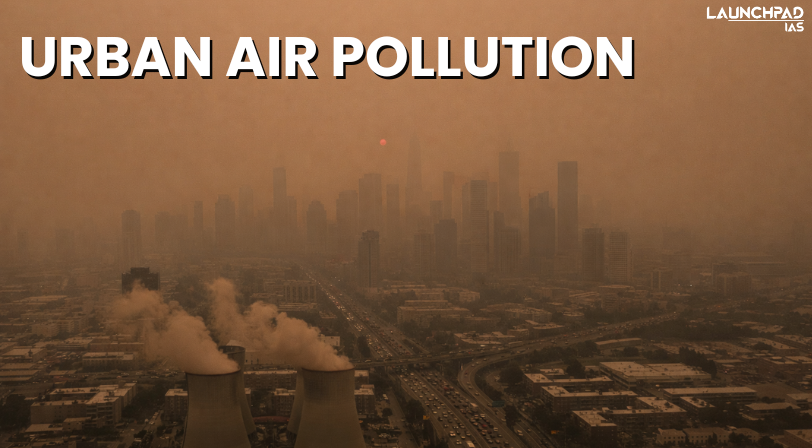
Urban air pollution is defined as the presence of harmful substances in the atmosphere of urban areas, primarily from anthropogenic sources such as vehicular emissions, industrial activities, and energy consumption, which contribute to respiratory and cardiovascular diseases.
Causes of Urban air pollution in India
- Meteorological Factors:
o Winter weather conditions like temperature inversion and low wind speeds trap pollutants near the ground and prevent their dispersion in cities like Delhi.
o Pre-Monsoon Dust Transport from Thar Desert and Middle East into Indian cities, in northern regions like Delhi. - Urban and Industrial Factors: Pollution from Industries like cement, steel, refineries, brick kilns (e.g., refineries and
chemical industries in Mumbai’s Chembur area), Vehicles (Delhi’s vehicles doubled since 2005), Construction and
Demolition Activities (e.g., rapid construction along Gurugram’s Golf Course Road) etc. - Urban layout: Narrow streets with tall buildings (street-canyon effect) trapping pollutants; Shrinking green/blue
spaces due to unplanned urban expansion reduces natural filtration etc. - Transboundary pollution: Pollution in Delhi due to seasonal stubble burning in neighboring states; Worsened air
quality over Chennai due to Aerosols transported from north India etc. - Other sources: Ground-level ozone (forms when NOx and VOCs react under strong sunlight); Burning firecrackers
during festivals; open waste burning, frequent landfill fires (e.g., Delhi, Ghaziabad, Bhalswa–Ghazipur landfills)
Impact of Air Pollution
- Health Impacts: Cardiovascular disease, respiratory infections, irritation in eyes etc.
o E.g., Air pollution linked to ~15% of all deaths in Delhi in 2023 (Centre for Research on Energy and Clean Air). - Environmental Impacts
o Climate Change: Pollutants like black carbon and ground-level ozone contribute to global warming.
o Acid Rain: Emissions of SO₂ and NOx react with water vapour to form acids, damaging soils, crops, forests. - Economic Losses: India lost economic output equivalent to 9.5% of GDP in 2022 due to air pollution. (The Lancet Countdown on Health and Climate Change report, 2025)
- Social Impacts:
o Reduced quality of life due to poor visibility, closure of schools and offices.
o Disproportionate impact on vulnerable groups like Children, elderly, and poor
Steps taken to curb the Air Pollution
- National Clean Air Programme (NCAP): Aims to reduce particulate matter concentrations by 40% by 2026 in 131 cities
- Graded Response Action Plan (GRAP): Emergency measures to combat air pollution in Delhi-NCR.
- Commission for Air Quality Management (CAQM), 2021: Statutory body established for improved air quality management in the National Capital Region.
- Measures for Vehicular Emission Control
o Leapfrogging to BS-VI fuel and vehicle standards (2020 nationwide).
o Transition to 20% Ethanol Blended Petrol (E-20)
o RFID system for toll & Environment Compensation Charge on commercial vehicles entering Delhi.
o Promotion of electric mobility under PM E-DRIVE Scheme, Electric Mobility Promotion Scheme 2024 (EMPS 2024).
o SATAT initiative for creating Compressed Bio-Gas (CBG) ecosystem. - Air Quality Monitoring & Data Systems
o National Air Quality Index (AQI) launched in 2015 .
o Installation of Online Continuous Emission Monitoring System (OCEMS) in red category air polluting industries
in Delhi-NC.
o System of Air Quality and Weather Forecasting and Research (SAFAR) Portal provides air quality updates.