
UPSC Syllabus Link: GS Paper I – Indian Geography, Geomorphology; GS Paper III – Environment, Disaster Management
Relevant for: UPSC Prelims, GS Paper I, GS Paper III and Essay
Introduction
India has a coastline of more than 7,500 km, including its mainland and island territories. This extensive coastline supports millions of people through fishing, agriculture, tourism, ports, shipping and other economic activities. At the same time, India’s coastal regions are increasingly exposed to hazards such as cyclones, storm surges, sea-level rise, flooding and coastal erosion.
For UPSC aspirants, coastal erosion is an important example of how a static Geography concept can become a multidimensional current-affairs issue. It connects coastal geomorphology with climate change, disaster management, livelihoods, infrastructure and environmental governance.
The important question is not simply what is coastal erosion? A good UPSC answer should also explain why it occurs, why certain regions are more vulnerable, how human activities intensify it and what can be done to manage the problem sustainably.
What is Coastal Erosion?
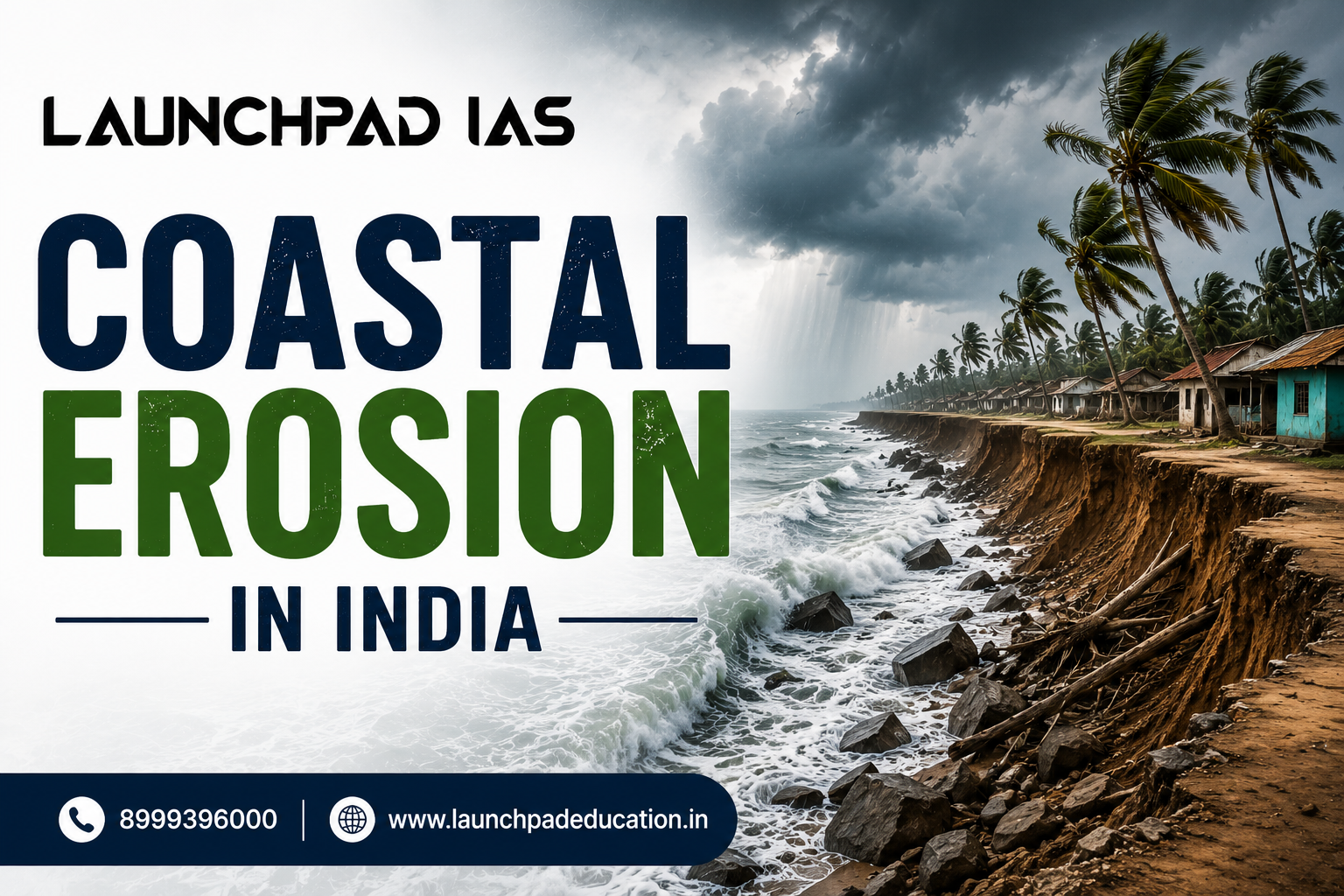
Coastal erosion refers to the gradual removal of sediments, rocks and soil from the coastline by natural processes such as waves, tides, currents and storms.
In simple terms, when the amount of material being removed from a coastal stretch is greater than the amount being deposited, the shoreline gradually moves landward.
It is important to understand that coastal erosion is not entirely a new or human-created phenomenon. Coastlines are naturally dynamic. However, human interventions, climate change and increasing development along coastal areas can alter sediment movement and increase the vulnerability of coastal communities.
Why is Coastal Erosion Important for UPSC?
Coastal erosion can be linked with several parts of the UPSC syllabus:
1. GS Paper I
· Coastal geomorphology
· Waves and tides
· Ocean currents
· Beaches and deltas
· Indian coastal geography
· Islands and coastal ecosystems
2. GS Paper III
· Climate change
· Disaster management
· Environmental degradation
· Sustainable development
· Coastal infrastructure
3. Essay
· Climate resilience
· Development versus environment
· Sustainable urbanisation
· Vulnerability of coastal communities
Therefore, preparing coastal erosion properly gives an aspirant material for multiple papers.
Major Causes of Coastal Erosion in India
Coastal erosion occurs because of a combination of natural processes and human interventions.
1. Wave Action
Continuous wave action removes and transports sediments along the coast.
During normal conditions, beaches may maintain a certain balance between erosion and deposition. However, intense wave activity can accelerate the removal of coastal material.
2. Longshore Currents
Waves approaching the coast at an angle can generate currents that transport sediments parallel to the shoreline.
This process is known as longshore drift.
When the natural movement of sediment is interrupted, some stretches may experience erosion because they no longer receive adequate sediment replenishment.
This is an important concept for understanding why erosion in one location can sometimes be connected with human intervention elsewhere along the same coastline.
3. Cyclones and Storm Surges
Tropical cyclones generate powerful winds, high waves and storm surges.
These can remove large quantities of beach sediments within a short period.
The east coast of India is particularly exposed to cyclones originating in the Bay of Bengal.
However, the west coast is also vulnerable to extreme weather events and coastal hazards.
4. Sea-Level Rise
Climate change has contributed to a rise in global mean sea level.
As sea levels rise, low-lying coastal areas become increasingly vulnerable to:
· Coastal flooding
· Saltwater intrusion
· Shoreline retreat
· Loss of wetlands
· Damage to coastal infrastructure
Sea-level rise does not automatically mean that every coastal area will experience the same degree of erosion. Local geology, sediment supply, coastal morphology and human interventions also matter.
5. Reduction in Sediment Supply
Rivers transport enormous quantities of sediments from the interior towards the coast.
However, dams, reservoirs, river regulation and other interventions can reduce the amount of sediment reaching deltas and coastal areas.
This can disturb the natural sediment budget.
For UPSC, remember the concept:
Reduced sediment supply → sediment deficit → increased vulnerability of certain coastal stretches to erosion.
6. Ports and Coastal Infrastructure
Construction of:
· Ports
· Harbours
· Breakwaters
· Groynes
· Sea walls
· Coastal roads
can alter natural wave and sediment dynamics.
Such structures may protect one particular stretch but potentially increase erosion in another location by interfering with longshore sediment transport.
Therefore, coastal engineering solutions must be site-specific and scientifically assessed.
7. Sand Mining
Excessive extraction of sand from beaches, dunes and river systems can reduce the availability of sediments required to maintain coastal stability.
Unregulated extraction can therefore increase the vulnerability of coastal areas to erosion.
8. Coastal Urbanisation and Tourism
Rapid development of:
· Hotels
· Resorts
· Roads
· Residential areas
· Commercial infrastructure
can disturb dunes, wetlands and other natural coastal buffers.
This can increase exposure to erosion and other coastal hazards.
Which Parts of India are Vulnerable?
India’s coastline is highly diverse.
It includes:
· Sandy beaches
· Rocky coasts
· Mudflats
· Estuaries
· Deltas
· Mangrove ecosystems
· Coral islands
· Lagoons
Therefore, the causes and intensity of erosion vary from one region to another.
States along both the eastern and western coasts can experience coastal erosion, although the nature and drivers of erosion differ.
The Sundarbans, major deltaic regions, low-lying coastal areas and certain densely populated stretches are particularly important from the perspective of coastal vulnerability.
Impacts of Coastal Erosion
1. Loss of Land
The most direct consequence is the gradual loss of coastal land.
This can affect:
· Agricultural fields
· Villages
· Roads
· Houses
· Public infrastructure
For densely populated coastal regions, even relatively small changes in the shoreline can have significant consequences.
2. Threat to Coastal Communities
Millions of people depend on coastal ecosystems for their livelihoods.
Fishing communities are particularly dependent on healthy coastal ecosystems and stable access to the sea.
Erosion can therefore create economic insecurity and, in severe cases, contribute to displacement.
3. Damage to Infrastructure
Ports, roads, railway lines, tourist facilities, power infrastructure and settlements located close to the coastline can become increasingly vulnerable.
The economic cost can become particularly high when erosion interacts with cyclones and storm surges.
4. Agricultural Impacts
Coastal erosion can reduce agricultural land.
In addition, saltwater intrusion can degrade soil and freshwater resources, particularly in low-lying coastal areas.
This can adversely affect agricultural productivity and food security.
5. Ecological Damage
Coastal ecosystems act as natural barriers against storms and erosion.
Important ecosystems include:
· Mangroves
· Coral reefs
· Sand dunes
· Salt marshes
· Coastal wetlands
Their degradation can create a vicious cycle:
Ecosystem degradation → weaker natural protection → greater vulnerability → further environmental damage.
Coastal Erosion and Climate Change
Climate change is increasingly relevant to the coastal erosion debate.
Its major linkages include:
Climate change → sea-level rise + changes in extreme weather → increased coastal vulnerability
However, UPSC answers should avoid presenting climate change as the only cause.
A balanced answer should mention:
Natural processes + human interventions + climate-related factors
This demonstrates conceptual maturity.
Government Measures and Institutional Response
India has adopted several approaches to address coastal vulnerability, including shoreline monitoring, coastal-zone regulation, disaster preparedness, ecosystem conservation and scientific assessment.
1. National Centre for Coastal Research
The National Centre for Coastal Research (NCCR) under the Ministry of Earth Sciences is involved in monitoring and studying shoreline changes along India’s coast.
Its work helps in identifying vulnerable stretches and supporting scientific coastal management.
2. Coastal Regulation Zone Framework
The Coastal Regulation Zone (CRZ) framework regulates certain activities in ecologically sensitive and vulnerable coastal areas.
Its broader objective is to balance:
Coastal development + environmental protection + livelihood security
For UPSC, CRZ should be studied as an example of environmental governance rather than simply memorising notification dates.
3. Integrated Coastal Zone Management
The integrated approach focuses on managing the coastline as a connected system rather than treating individual erosion sites separately.
It considers:
· Ecosystems
· Communities
· Infrastructure
· Economic activities
· Disaster risk
· Coastal processes
This approach is more sustainable than relying exclusively on hard engineering structures.
Hard Engineering vs Nature-Based Solutions
This is an excellent analytical dimension for UPSC Mains.
Hard Engineering
Examples include:
· Sea walls
· Groynes
· Breakwaters
· Revetments
These can provide immediate protection to particular stretches.
However, they can sometimes alter sediment transport and transfer erosion to neighbouring areas.
Nature-Based Solutions
These include:
· Mangrove restoration
· Dune conservation
· Wetland protection
· Beach nourishment
· Restoration of natural coastal buffers
Nature-based approaches can provide multiple benefits, including biodiversity conservation and climate resilience.
Therefore, the best approach is not necessarily engineering versus nature, but scientifically designed combinations suited to local coastal conditions.
Way Forward
India needs a long-term and region-specific strategy for managing coastal erosion.
1. Scientific Shoreline Monitoring
Regular satellite-based and field-based monitoring should identify erosion hotspots and changing shoreline patterns.
2. Integrated Coastal Zone Management
Coastal planning should consider the entire sediment system rather than individual administrative boundaries.
3. Protection of Natural Buffers
Mangroves, dunes, wetlands and other coastal ecosystems should be treated as natural infrastructure.
4. Regulated Coastal Development
Infrastructure development should account for hazard maps, erosion trends and future climate risks.
5. Community Participation
Fishing communities and other coastal populations should be involved in coastal planning because they possess valuable local knowledge and are directly affected by policy decisions.
6. Climate-Resilient Infrastructure
Critical infrastructure in vulnerable areas should be designed according to future rather than only present-day risk.
Coastal Erosion: UPSC Prelims Perspective
For Prelims, focus on concepts rather than memorising isolated statistics.
Important areas include:
· Longshore drift
· Wave action
· Coastal deposition
· Sea-level rise
· Deltas
· Estuaries
· Mangroves
Coastal Regulation Zone
National Centre for Coastal Research
Shoreline monitoring
Coastal ecosystems
A common UPSC trap is to assume that every coastal structure reduces erosion everywhere. The impact of a structure depends on local wave conditions, sediment movement and coastal morphology
.
Coastal Erosion: UPSC Mains Perspective
A good GS answer should follow a logical structure:
Introduction
Define coastal erosion and establish its relevance.
Body
Natural causes
Anthropogenic causes
Climate-change dimension
Regional vulnerability
Socio-economic impacts
Ecological impacts
Government measures
Way Forward
Integrated coastal management
Ecosystem-based adaptation
Scientific monitoring
Sustainable infrastructure
Community participation
Conclusion
End by emphasising the need to treat the coastline as a dynamic ecosystem rather than merely a zone available for infrastructure development.
A Useful Mains Framework
A simple framework can help you remember the topic:
CAUSES
Natural + Human + Climate
↓
PROCESS
Sediment imbalance + Wave action + Longshore transport
↓
IMPACTS
Land loss + Livelihoods + Infrastructure + Ecosystems
↓
RESPONSE
Regulation + Monitoring + Ecosystem restoration + Resilient infrastructure
This framework can be used to construct a complete 10- or 15-mark answer within the examination.
Frequently Asked Questions
What is the main cause of coastal erosion?
There is no single cause. Coastal erosion results from the interaction of waves, tides, currents, storms, sediment availability, coastal morphology and human interventions.
How does sea-level rise affect coastal areas?
Sea-level rise increases the exposure of low-lying coastal regions to flooding, saltwater intrusion and shoreline retreat.
Can sea walls completely solve coastal erosion?
No. Sea walls can protect specific locations but may alter coastal sediment dynamics and potentially increase erosion elsewhere if not properly designed.
Why are mangroves important for coastal protection?
Mangroves can reduce wave energy, trap sediments and provide a natural buffer against storms and coastal hazards.
Why is coastal erosion important for UPSC?
It connects Physical Geography with climate change, environmental governance, disaster management, livelihoods and sustainable development, making it relevant across multiple parts of the UPSC syllabus.
Conclusion
Coastal erosion is not simply a problem of disappearing beaches. It represents a broader challenge involving geomorphological processes, human development, climate change, livelihoods and environmental governance.
For UPSC aspirants, the most important lesson is to avoid studying coastal erosion as an isolated environmental issue. Understand the coastal processes, identify the human interventions, analyse the socio-economic and ecological consequences, and then evaluate the governance and adaptation measures.
A well-prepared aspirant should be able to connect coastal erosion with climate resilience, disaster management, sustainable development and India’s long-term coastal security.
That is the difference between merely knowing a Geography topic and being able to use it effectively in a UPSC Mains answer.

UPSC CSE 2028 ONLINE
🚀 UPSC 2028 Online Foundation Course
A complete recorded foundation program for UPSC CSE 2028 aspirants. Get comprehensive GS coverage, Current Affairs classes, Answer Writing Guidance, Tests, Mentorship, and Doubt-Clearing Sessions. Access high-quality video lectures and PDF study material anytime, anywhere through the Launchpad IAS App.
🎯 Designed for beginners.
📚 Recorded Classes + PDF Notes.
🏆 Structured Preparation for UPSC CSE 2028.
Complete UPSC Bookset
UPSC Bookset
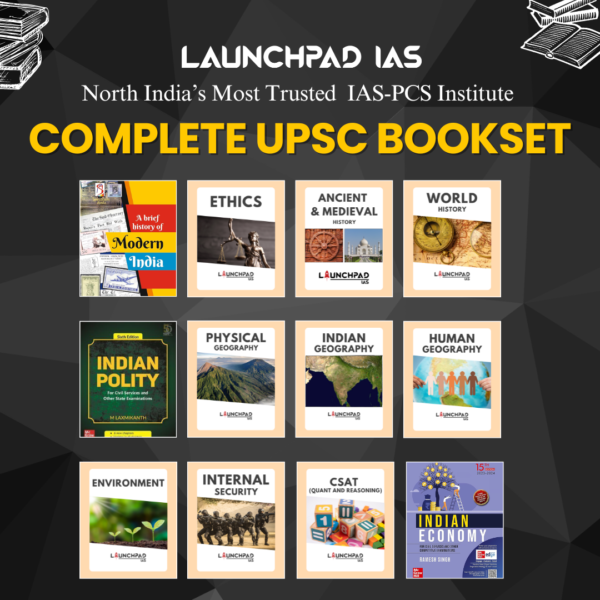
Our UPSC Bookset is designed to help you prepare effectively for the IAS-IPS exams. It includes comprehensive study materials and practice resources tailored to cover the entire syllabus.
Features:
- Complete Coverage: All essential subjects and topics included.
- Latest Edition: Updated with the most recent exam patterns and guidelines.
- Easy to Understand: Simplified explanations and clear diagrams.
- Practice Questions: A wide range of practice questions to test your knowledge.
List of Books:
- Indian Polity (Laxmikant)
- Indian Economy (Ramesh Singh)
- Modern History (Spectrum)
- LaunchPad CSAT Book
- LaunchPad Environment Book
- LaunchPad Ancient & Medieval History Book
- LaunchPad World History Book
- LaunchPad Internal Security Book
- LaunchPad Ethics Book
- LaunchPad Physical Geography
- LaunchPad Human Geography Book
- LaunchPad Indian Geography
- Digital Notes & Ncert PDFS