When we talk about India’s energy security, the discussion usually revolves around crude oil imports, renewable energy and electric vehicles. But there is another important piece of the puzzle that often gets less attention: ethanol blending in petrol.
The E20 initiative is part of India’s broader strategy to reduce dependence on imported crude oil, support farmers and sugarcane producers, and move towards cleaner fuels.
For UPSC aspirants, E20 is a good example of how energy security, agriculture, environment and economic policy intersect.
What is E20?
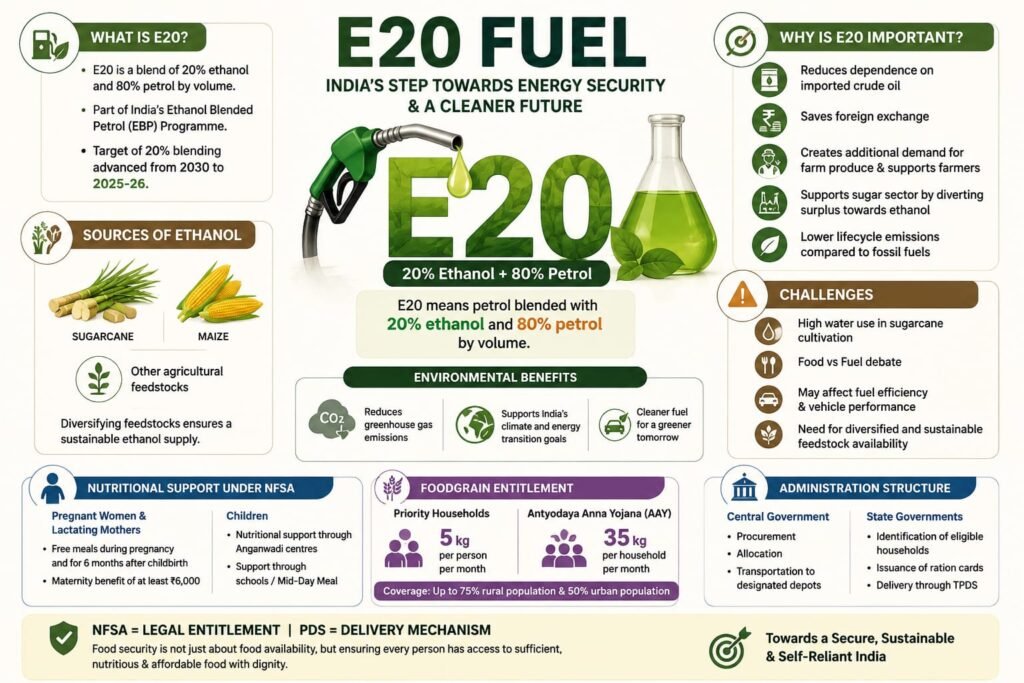
- E20 means petrol blended with 20% ethanol and 80% petrol by volume.
- Here, “E” stands for ethanol and “20” represents the percentage of ethanol blending.
- For example, one litre of E20 fuel contains approximately:
- 200 ml ethanol + 800 ml petrol
- India has been progressively increasing ethanol blending under the Ethanol Blended Petrol (EBP) Programme.
- The original target of achieving 20% ethanol blending by 2030 was subsequently advanced to 2025–26.
Why Does India Need Ethanol Blending?
- India is heavily dependent on imported crude oil.
- This creates several economic and strategic vulnerabilities:
- High crude oil import bill
- Exposure to international oil prices
- Pressure on the current account
- Exchange-rate vulnerability
- Energy security concerns
Therefore, increasing the use of domestically produced ethanol can help substitute a portion of petrol consumption.
In simple terms:
More domestic ethanol + less petrol requirement = lower dependence on imported crude oil Of course, ethanol cannot eliminate India’s oil dependence. But it can reduce it at the margin.
Ethanol: Where Does It Come From?
Ethanol used for blending can be produced from various agricultural feedstocks.
Major sources include:
Sugarcane
Maize
Other agricultural materials can also be used depending on technology and policy.
This makes ethanol an important link between agriculture and energy security.
India has also encouraged production from different feedstocks to diversify the ethanol supply base.
E20 and Farmers
One of the major economic arguments in favour of ethanol blending is its potential to create an additional market for agricultural produce.
Sugar mills can divert part of their sugarcane output towards ethanol production.
Similarly, maize can also become an important feedstock.
This can:
- Create additional demand for agricultural produce
- Provide an alternative revenue stream for farmers
- Help manage excess sugar production
- Support the rural economy
However, this relationship is not completely straightforward.
Excessive dependence on water-intensive crops such as sugarcane can raise concerns about water stress and sustainability.
This is where UPSC analysis becomes important.
Environmental Benefits
E20 can contribute to reducing the lifecycle carbon intensity of petrol, depending on how ethanol is produced.
Ethanol is a biofuel, and its use can potentially reduce greenhouse-gas emissions compared with conventional fossil fuels.
It can therefore support India’s broader climate and energy-transition goals.
But remember:
E20 is not a zero-emission fuel.
Its environmental benefits depend on factors such as:
- Feedstock used
- Farming practices
- Water consumption
- Processing technology
E20 and Vehicle Compatibility
- Transportation
- Overall lifecycle emissions
So, a good UPSC answer should avoid presenting ethanol as an automatically “green” fuel.
This is an important practical issue.
Ethanol has different chemical and combustion properties compared with petrol.
Higher ethanol blends can affect:
- Fuel efficiency
- Engine components
- Fuel-system compatibility
- Vehicle performance
Therefore, automobile manufacturers have been developing and certifying vehicles compatible with higher ethanol blends.
For UPSC, the broader point is:
Energy-transition policies require changes not only in fuel supply but also in infrastructure and technology.
Economic Significance of E20
E20 can have multiple economic benefits.
1. Lower Oil Import Dependence
Replacing a portion of petrol with domestically produced ethanol can reduce demand for imported crude oil.
2. Foreign Exchange Savings
Lower crude imports can potentially reduce the foreign exchange outflow.
3. Rural Economic Activity
Ethanol production creates demand for agricultural feedstocks and supports associated industries.
4. Sugar Sector Support
Diversion of sugar towards ethanol can help address the problem of surplus sugar production.
But There Are Challenges Too
A UPSC-ready analysis must go beyond the benefits.
- Water Consumption
Sugarcane is a water-intensive crop. Expanding ethanol production from sugarcane in water-stressed regions can create sustainability concerns.
- Food vs Fuel
Using agricultural crops for fuel can create a potential food-versus-fuel debate, particularly if feedstock demand affects food availability or prices.
- Vehicle Efficiency
Ethanol contains less energy per litre than petrol. Higher ethanol blends can therefore affect fuel economy.
- Feedstock Availability
India needs a reliable and diversified supply of ethanol to maintain high blending levels.
- Lifecycle Emissions
The actual environmental benefit depends on how the ethanol is produced and transported.
E20 and India’s Energy Transition
E20 should not be seen as a replacement for electric vehicles, hydrogen or renewable energy.
Instead, it is one component of India’s diversified energy-transition strategy.
India’s approach broadly includes:
Ethanol → Biofuels
Solar/Wind → Renewable electricity
EVs → Electrification of transport
Green Hydrogen → Low-carbon industrial fuel
The long-term objective is to reduce dependence on fossil fuels while maintaining
energy security and economic growth.
UPSC Perspective
- For Prelims, remember:
E20 = 20% ethanol + 80% petrol
And remember that the ethanol-blending target was advanced from 2030 to 2025–26.
- For Mains, don’t write only about pollution reduction.
Link E20 with:
Energy Security + Agriculture + Import Dependence + Rural Economy + Environment + Water Stress + Food Security
A balanced conclusion would be:
E20 can strengthen India’s energy security and support the rural economy, but its long-term sustainability depends on feedstock diversification, water-efficient agriculture, technological adaptation and lifecycle emission reduction.
UPSC Prelims MCQs
Q1. With reference to E20 fuel, consider the following statements:
1. E20 refers to petrol containing 20% ethanol by volume.
2. Ethanol blending can help reduce India’s dependence on imported crude oil.
3. E20 is a completely zero-emission fuel.
Which of the statements given above is/are correct?
A. 1 and 2 only
B. 2 and 3 only
C. 1 and 3 only
D. 1, 2 and 3
Answer: A
Explanation: E20 contains approximately 20% ethanol and 80% petrol by volume. Greater domestic ethanol use can reduce dependence on imported petroleum. However, E20 is not a zero-emission fuel; its environmental impact must be assessed on a lifecycle basis.
Q2. Consider the following as potential implications of increasing ethanol blending in petrol:
1. Reduction in crude oil import dependence
2. Additional demand for agricultural feedstocks
3. Potential support to the sugar sector
4. Complete elimination of India’s dependence on fossil fuels
Which of the above are correct?
A. 1, 2 and 3 only
B. 1 and 4 only
C. 2, 3 and 4 only
D. 1, 2, 3 and 4
Answer: A
Explanation: Ethanol blending can reduce a portion of petroleum demand and create additional markets for agricultural feedstocks. It can also support the sugar sector. However, E20 cannot eliminate India’s overall dependence on fossil fuels.
One-Line Revision
E20 = 20% ethanol + 80% petrol → Energy security + lower oil-import dependence + agricultural demand + cleaner fuel transition, but with challenges of water use, feedstock availability and vehicle compatibility.
UPSC Mentor’s Take
Don’t study E20 as just a biofuel fact. Treat it as an example of the energy–agriculture–environment nexus. This interconnection is exactly what makes the topic useful for both Prelims and GS-III Mains.