
- IOD or Indian Nino:
- Indian Ocean Dipole (IOD), sometimes referred to as the Indian Nino, is similar to the El Nino phenomenon, occurring in the relatively smaller area of the Indian Ocean between the Indonesian and Malaysian coastline in the east and the African coastline near Somalia in the west.
- The El Nino is the warmer-than-normal phase of the El Nino Southern Oscillation (ENSO) phenomenon, during which there are generally warmer temperatures and less rainfall than normal in many regions of the world, including India.
- One side of the ocean, along the equator, gets warmer than the other.
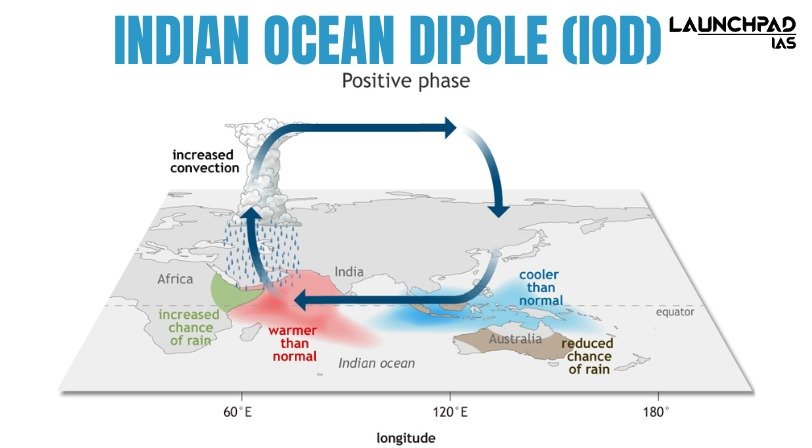
- IOD is said to be positive when the western side of the Indian Ocean, near the Somalia coast, becomes warmer than the eastern Indian Ocean.
- It is negative when the western Indian Ocean is cooler.
- Indian Ocean Dipole (IOD), sometimes referred to as the Indian Nino, is similar to the El Nino phenomenon, occurring in the relatively smaller area of the Indian Ocean between the Indonesian and Malaysian coastline in the east and the African coastline near Somalia in the west.
- Mechanism:
- Negative IOD:
- The air circulation in the Indian Ocean basin moves from west to east, that is from the African coast towards the Indonesian islands, near the surface, and in the opposite direction at the upper levels. That means the surface waters in the Indian Ocean get pushed from west to east.
- In a normal year, warmer waters in the western Pacific near Indonesia cross over into the Indian Ocean and make that part of the Indian Ocean slightly warmer. That causes the air to rise and helps the prevailing air circulation.
- In the years when the air circulation becomes stronger, more warm surface waters from the African coast are pushed towards the Indonesian islands, making that region warmer than usual. This causes hotter air to rise, and the cycle reinforces itself.
- This is the state of negative IOD.
- Positive IOD:
- Air circulation becomes slightly weaker than normal. In some rare cases, the air circulation even reverses direction. The consequence is that the African coast becomes warmer while the Indonesian coastline gets cooler.
- A positive IOD event is often seen developing at times of an El Nino, while a negative IOD is sometimes associated with La Nina.
- During El Nino, the Pacific side of Indonesia is cooler than normal because of which the Indian Ocean side also gets cooler. That helps the development of a positive IOD.
- Air circulation becomes slightly weaker than normal. In some rare cases, the air circulation even reverses direction. The consequence is that the African coast becomes warmer while the Indonesian coastline gets cooler.
- Impact of IOD:
- In the Indian Ocean, IOD exhibits an ocean-atmosphere interaction that closely resembles the fluctuations observed during El Niño events in the Pacific Ocean. However, the IOD is considerably less powerful compared to El Niño, resulting in relatively minimal impacts.
- A positive IOD helps rainfall along the African coastline and also over the Indian sub-continent while suppressing rainfall over Indonesia, southeast Asia and Australia. The impacts are opposite during a negative IOD event.
- Past Events:
- In 2019 the IOD event developed during the late monsoon but was so strong that it compensated for the deficit rainfall during the first month of the monsoon season (June had 30% deficiency that year).
- The deficit in June that year was also attributed to a developing El Nino but that fizzled out later.
- In 2019 the IOD event developed during the late monsoon but was so strong that it compensated for the deficit rainfall during the first month of the monsoon season (June had 30% deficiency that year).
What is ENSO
- In a normal year, the eastern side of the Pacific Ocean, near the north western coast of South America, is cooler than the western side near the islands of Philippines and Indonesia.
- This happens because the prevailing wind systems that move from east to west sweep the warmer surface waters towards the Indonesian coast.
- The relatively cooler waters from below come up to replace the displaced water.
- An El Nino event is the result of a weakening of wind systems that leads to lesser displacement of warmer waters.
- This results in the eastern side of the Pacific becoming warmer than usual. During La Nina, the opposite happens.
- Both these conditions, together called El Nino Southern Oscillation (ENSO), affect weather events across the world.
- Over India, the El Nino has the impact of suppressing monsoon rainfall.