
Background:
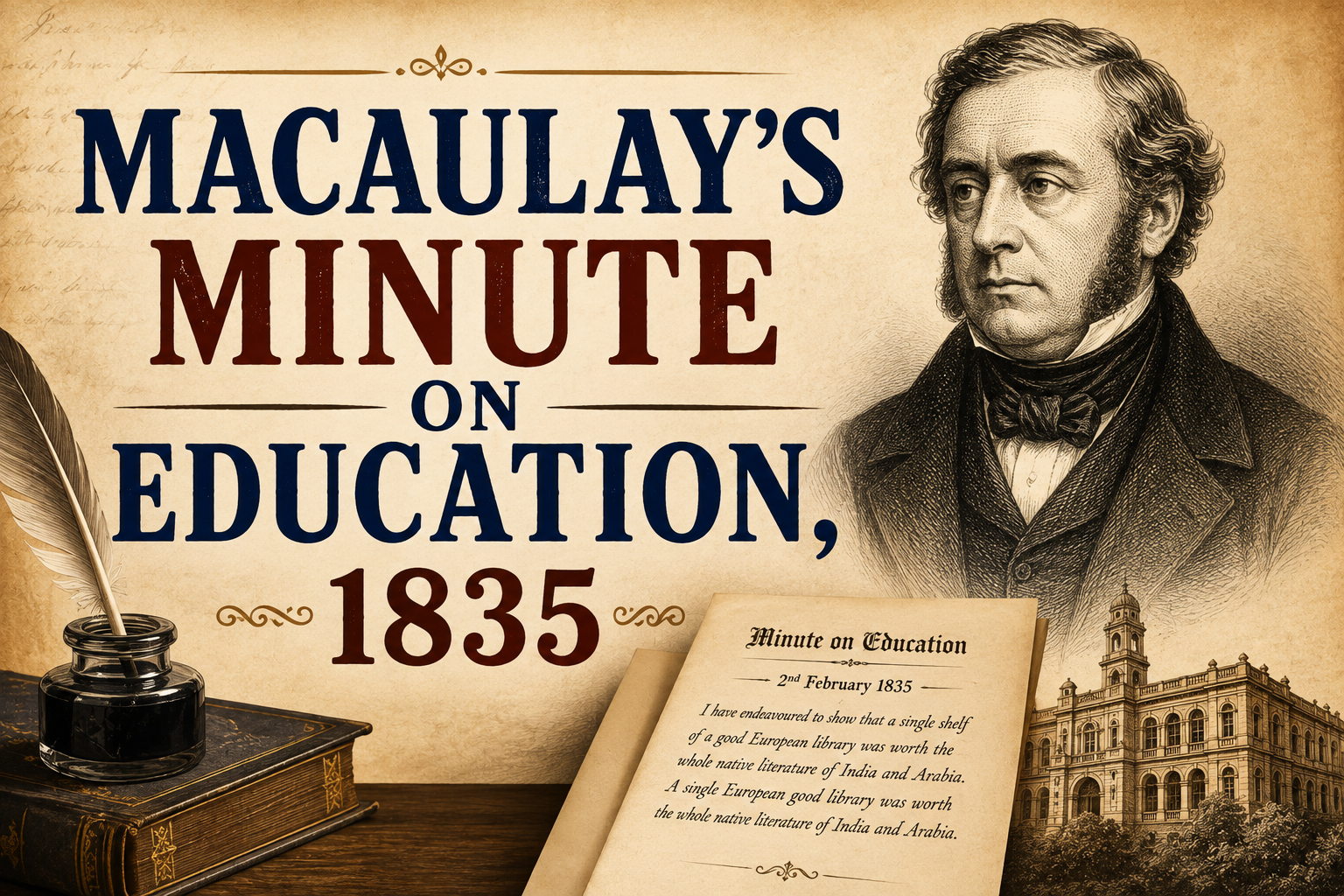
The debate over the nature of education in British India was broadly divided between the Orientalists, who favoured Arabic and Sanskrit learning, and the Anglicists, who advocated Western knowledge through the medium of English. In this context, Thomas Babington Macaulay, the Law Member of the Governor-General’s Council and President of the General Committee of Public Instruction, presented his famous Minute on Indian Education on 2 February 1835.
Core Argument:
Macaulay argued that the limited educational funds should be used for imparting what he considered the most useful modern knowledge. He strongly favoured English education over Sanskrit and Arabic, claiming that European literature and scientific knowledge were superior and more practically useful.
His argument was not merely linguistic; it represented a broader Anglicist vision of education, in which Western literature, science and philosophy would become the foundation of higher education in India.
The “Downward Filtration Theory”:
The most important policy idea in the Minute was to educate a small section of Indians who could subsequently transmit Western knowledge to the wider population. Macaulay proposed creating a class that would act as intermediaries between the colonial rulers and the Indian masses—“Indian in blood and colour” but trained in English intellectual and cultural traditions.
Thus, instead of immediately educating the entire population, the colonial state would concentrate its limited resources on the upper and middle sections, expecting knowledge eventually to filter downward through them.
Macaulay’s View on Traditional Learning:
Macaulay was highly dismissive of much of the existing Oriental curriculum. He argued that government funds should not continue to support educational institutions merely because they taught Sanskrit or Arabic. His criticism extended to traditional systems of history, philosophy, medicine and astronomy, which he considered inferior to contemporary European knowledge.
From a modern historical perspective, these sweeping comparisons reveal the Eurocentric and colonial assumptions underlying his educational vision.
Significance:
The Minute became a major landmark in the transition towards English-medium, Western-oriented higher education under British rule. It strengthened the Anglicist position and provided an important intellectual justification for redirecting state educational expenditure towards English and European knowledge.
Its significance, however, should not be understood as the simple “introduction of education” into India. India already possessed diverse indigenous systems of learning. Rather, Macaulay’s intervention concerned the direction, language, curriculum and priorities of colonial state-sponsored education.
UPSC Takeaway:
Macaulay’s Minute of 1835 → Anglicist triumph → preference for English & Western knowledge → reduction of official patronage for Oriental learning → creation of an educated intermediary class → basis for the downward filtration approach.
One-line conclusion:
Macaulay’s Minute marked a decisive shift in colonial educational policy from Oriental learning towards English education and Western knowledge, while simultaneously revealing the cultural and political objectives embedded within British educational policy.

UPSC CSE 2028 ONLINE
🚀 UPSC 2028 Online Foundation Course
A complete recorded foundation program for UPSC CSE 2028 aspirants. Get comprehensive GS coverage, Current Affairs classes, Answer Writing Guidance, Tests, Mentorship, and Doubt-Clearing Sessions. Access high-quality video lectures and PDF study material anytime, anywhere through the Launchpad IAS App.
🎯 Designed for beginners.
📚 Recorded Classes + PDF Notes.
🏆 Structured Preparation for UPSC CSE 2028.