
UPSC CSE Preparation Guide | Prelims + Mains Strategy | Beginner’s Roadmap
Introduction
Starting UPSC Civil Services Examination preparation from scratch can feel overwhelming. The syllabus is vast, the competition is intense, and aspirants are surrounded by an enormous amount of books, coaching material, current-affairs content, test series and study plans.
But there is one principle every serious aspirant should understand at the beginning:
UPSC preparation is not a race to complete more material. It is a process of understanding the syllabus, building concepts, practising questions, revising repeatedly and improving through tests.
A beginner does not need ten books for every subject or a 14-hour study schedule. What is required is a clear direction, limited sources, disciplined revision and continuous assessment.
This guide explains how a beginner can approach UPSC CSE systematically, from understanding the examination to preparing for both Prelims and Mains.
1. Understand the UPSC Examination First
Before opening your first book, understand the examination.
The Civil Services Examination consists broadly of three stages:
Stage 1: Preliminary Examination
The Preliminary Examination consists of:
General Studies Paper I
General Studies Paper II, commonly known as CSAT
GS Paper I determines qualification for the Prelims cutoff, while CSAT is qualifying in nature.
Stage 2: Main Examination
The Mains examination consists of:
Essay
General Studies Paper I
General Studies Paper II
General Studies Paper III
General Studies Paper IV
Optional Subject papers
Qualifying language papers
Stage 3: Personality Test
Candidates who qualify for the written examination appear for the Personality Test/Interview.
The first mistake a beginner should avoid is preparing for these stages as if they were three completely unrelated examinations.
They are different in their demands, but the knowledge base overlaps significantly.
2. Start With the UPSC Syllabus
The syllabus should become the foundation of your preparation.
Do not begin with:
“Which book should I read?”
Begin with:
“What exactly does UPSC expect me to study?”
Take the official syllabus and divide it into individual topics.
For example, instead of writing:
Indian Geography
break it down into:
· Physical features
· Climate
· Monsoon
· Rivers
· Agriculture
· Natural resources
· Industries
· Population
· Urbanisation
· Disaster-related geography
This converts a huge syllabus into manageable units.
The syllabus should serve three purposes:
Before studying: It tells you what to study.
While studying: It keeps you focused.
During revision: It becomes your checklist.
3. Analyse Previous-Year Questions Before Starting Serious Preparation
Previous-Year Questions, or PYQs, are among the most valuable resources available to a UPSC aspirant.
Many beginners make the mistake of solving PYQs only after completing the syllabus.
A better approach is to use PYQs from the beginning.
PYQs help you understand:
What UPSC actually asks
The depth of knowledge required
Recurring themes
Conceptual areas
Question framing
Prelims elimination techniques
Mains analytical requirements
You may read a chapter and feel that you understand it completely. A PYQ can immediately reveal whether you can actually apply that knowledge.
Therefore:
The syllabus tells you the boundary.
PYQs tell you the examiner’s demand.
4. Build Your Foundation Before Chasing Advanced Material
A beginner should first develop conceptual clarity.
For subjects where your basics are weak, NCERTs can be useful.
The objective of reading basic books is not to memorise every line. It is to understand fundamental concepts.
For example, before studying advanced climatology, you should understand:
· Atmospheric pressure
· Winds
· Humidity
· Clouds
· Rainfall
· Air masses
· Ocean-atmosphere interactions
Similarly, before studying Indian Polity in depth, understand basic constitutional concepts.
The principle is simple:
Weak foundation + advanced material = confusion.
Strong foundation + standard sources = efficient preparation.
5. Follow Limited and Reliable Sources
One of the biggest problems in UPSC preparation today is information overload.
An aspirant may have:
One coaching institute’s notes
Another institute’s PDFs
Multiple Telegram channels
Several YouTube playlists
Newspaper notes
Current-affairs magazines
Test-series material
Different teachers’ handouts
The result is often more collecting and less studying.
Instead, follow a limited-source strategy.
For every subject, ideally have:
One primary source + PYQs + test material + your own revision notes
The objective is to revise the same material multiple times.
A book that has been revised four times is usually more valuable than four books that have been read once.
6. Prepare Static Subjects Systematically
The UPSC syllabus contains several subjects that require sustained preparation.
A practical approach is to build the static foundation first and then continuously revise it.
Major areas include:
History
Focus on:
· Ancient India
· Medieval India
· Modern India
· Art and Culture
· Freedom Struggle
Geography
Focus on:
· Physical Geography
· Indian Geography
· World Geography
· Climatology
· Oceanography
· Economic Geography
· Mapping
Polity
Focus on:
· Constitution
· Fundamental Rights
· Parliament
· Judiciary
· Executive
· Federalism
· Constitutional and statutory bodies
· Governance
Economy
Focus on:
· Basic economic concepts
· Banking
· Inflation
· Monetary policy
· Fiscal policy
· Budget
· External sector
· Agriculture
· Economic reforms
Environment
Focus on:
· Ecology
· Biodiversity
· Climate change
· Pollution
· Environmental conventions
· Protected areas
· Conservation programmes
The goal is not to finish these subjects once.
The goal is to create a revision-ready knowledge base.
7. How to Prepare Current Affairs
Current affairs is necessary, but it should not consume your entire preparation.
The biggest mistake is trying to remember every event appearing in the newspaper.
Instead, ask:
“Why is this important for UPSC?”
For example, if coastal erosion appears in the news, do not make a note containing only the news event.
Connect it with:
· Coastal geomorphology
· Longshore drift
· Sea-level rise
· Cyclones
· Coastal Regulation Zone
· Disaster management
· Mangroves
· Climate resilience
This is how current affairs should be integrated with static knowledge.
A useful formula:
Current Affair → Static Concept → Syllabus → PYQ → Possible Mains Question
This approach makes current affairs much more manageable.
8. Prepare Prelims and Mains Together
A common mistake is:
“First I will prepare for Prelims, then I will start Mains.”
Although the final preparation phases are different, the foundation should overlap.
For example:
While studying Indian Polity:
Learn constitutional concepts for Prelims.
Solve objective questions.
Understand constitutional debates and governance issues for Mains.
Practice analytical questions.
Similarly, while studying Geography:
Learn factual and conceptual aspects for Prelims.
Practice maps.
Understand causes, consequences and spatial patterns for Mains.
Connect geographical issues with current affairs.
This integrated approach reduces duplication of effort.
9. How to Prepare for UPSC Prelims
Prelims requires a combination of knowledge, accuracy, elimination and time management.
Focus on Conceptual Clarity
Do not rely entirely on memorisation.
UPSC often frames questions in ways that test whether you understand a concept.
Solve PYQs
Solve previous UPSC Prelims questions repeatedly.
Analyse why each option is correct or incorrect.
Practise Mock Tests
Initially, sectional tests can be useful.
Later, move towards full-length tests.
But remember:
Test analysis is more important than simply counting your test scores.
After every test, classify mistakes into:
· Lack of knowledge
· Conceptual confusion
· Incorrect interpretation
· Guessing error
· Silly mistake
· Time-pressure error
This tells you what actually needs improvement.
10. The Importance of Revision for Prelims
Prelims preparation is not complete when you finish a book.
It is complete when you can recall and apply the information under examination conditions.
A practical revision cycle can look like:
First Reading → Short Revision → PYQs → Second Revision → Tests → Final Revision
Do not underestimate the importance of repeated revision.
In UPSC preparation, retention often becomes a bigger challenge than reading.
11. How to Prepare for UPSC Mains
Mains is fundamentally different from Prelims.
It tests:
· Understanding
· Analysis
· Argumentation
· Examples
· Structure
· Expression
· Time management
You should therefore gradually develop the ability to answer:
· What?
· Why?
· How?
· Impact?
· Challenges?
· Way Forward?
For example, instead of merely knowing that urbanisation is increasing, you should be able to discuss:
· Causes
· Opportunities
· Problems
· Governance challenges
· Environmental consequences
· Policy solutions
That is the transition from information to analysis.
12. Start Answer Writing Gradually
You do not need to write full-length Mains tests immediately after beginning preparation.
Start with individual questions.
Initially focus on:
· Understanding the question
· Identifying the demand
· Creating a basic structure
· Writing concise introductions
· Developing analytical points
· Using examples
· Writing balanced conclusions
Gradually introduce:
· Timed answer writing
· Sectional tests
· Full-length GS papers
The objective is to make answer writing a skill rather than something you begin only after completing the entire syllabus.
13. Learn to Structure a Mains Answer
A basic structure can be:
Introduction
Define the issue, provide context or mention a relevant fact.
Body
Divide the answer into logical dimensions.
For example:
Causes → Impacts → Challenges → Government Measures → Way Forward
Use:
Examples
Data where relevant
Constitutional provisions
Committees
Government schemes
Diagrams
Maps
Case studies
Conclusion
End with a balanced and forward-looking statement.
A good conclusion should not simply repeat the introduction.
14. Give Importance to Diagrams and Maps
Presentation matters in Mains.
A simple diagram can communicate an idea faster than a long paragraph.
For Geography, maps are particularly valuable.
For example, while answering a question on the Indian Monsoon, you can draw:
Arabian Sea Branch → Western Ghats
Bay of Bengal Branch → Northeast → Northern Plains
Similarly, flowcharts can be used in:
· Governance
· Economy
· Environment
· Disaster Management
· Social Issues
The purpose is not to decorate the answer.
The purpose is to communicate more information efficiently.
15. Choose the Optional Subject Carefully
Optional subject selection should not be based purely on:
· What toppers selected
· Which subject is supposedly “scoring”
· What your friends are studying
· Which subject is trending
Consider:
· Your academic background
· Genuine interest
· Availability of quality resources
· Syllabus size
· Previous familiarity
· PYQs
· Your ability to write analytical answers
Once selected, avoid changing the optional repeatedly unless there is a compelling reason.
Optional preparation requires depth and continuity.
16. CSAT Should Not Be Ignored
Although CSAT is qualifying in nature, ignoring it can become a serious mistake.
Candidates who are weak in:
· Quantitative aptitude
· Logical reasoning
· Reading comprehension
should begin CSAT preparation early.
A sensible approach is:
Understand the basics → Solve PYQs → Identify weak areas → Practise regularly → Take timed tests
Do not wait until the final few weeks if CSAT is one of your weak areas.
17. Create a Realistic Study Schedule
A UPSC timetable should be based on output rather than hours.
Instead of saying:
“I will study for 12 hours.”
Set measurable targets:
Complete one Geography topic
· Solve 25 PYQs
· Revise Polity chapters
· Read and analyse current affairs
· Write two Mains answers
· Attempt one sectional test
This makes preparation measurable.
A productive day should ideally include a combination of:
New Learning + Revision + Practice
The exact number of hours varies from person to person.
Consistency matters more than an unrealistic schedule that cannot be maintained.
18. How Many Hours Should You Study?
There is no universally correct number.
Some aspirants may be productive for 6–8 focused hours, while others may need more.
The important question is:
What did you accomplish during those hours?
Eight hours of focused study with revision and practice can be more valuable than twelve hours of passive reading interrupted by social media and constant source switching.
Therefore, measure:
· Topics completed
· Questions solved
· Revision completed
· Tests attempted
· Mistakes analysed
rather than simply counting study hours.
19. Common Mistakes Beginners Should Avoid
1. Collecting Too Many Resources
More PDFs do not mean more preparation.
2. Ignoring PYQs
PYQs should be part of preparation from the beginning.
3. Making Huge Notes
Notes should make revision faster, not create another textbook.
4. Reading Current Affairs All Day
Current affairs should support static preparation.
5. Constantly Changing Strategy
Give a strategy enough time to produce measurable results before changing it.
6. Ignoring Revision
Without revision, most information gradually disappears.
7. Delaying Test Practice
Testing should begin before the final stage.
8. Comparing Your Journey With Other Aspirants
Different educational backgrounds, preparation levels and circumstances make direct comparison misleading.
20. A Practical UPSC Preparation Cycle
A beginner can think of preparation in five broad stages:
Stage 1: Foundation
Build basic concepts and understand the syllabus.
Stage 2: Consolidation
Complete standard sources and integrate PYQs.
Stage 3: Revision
Revise repeatedly and identify weak areas.
Stage 4: Testing
Increase sectional and full-length tests.
Stage 5: Examination-Specific Preparation
Focus on Prelims or Mains according to the examination calendar.
The cycle should not be viewed as strictly linear. Revision and testing should continue throughout the preparation.
21. How to Know Whether Your Preparation Is Actually Improving
Do not judge your preparation only by the number of books completed.
Instead, ask yourself:
· Can I explain the topic without looking at my notes?
· Can I solve related PYQs?
· Can I eliminate incorrect options?
· Can I write a structured Mains answer?
· Can I recall the topic after several weeks?
· Are my test mistakes reducing?
· Am I improving my weak subjects?
These are much better indicators of progress.
22. A Beginner’s Golden Rule
If you remember only one framework from this article, remember:
Syllabus → Standard Sources → PYQs → Revision → Tests → Analysis → Improvement
This cycle should remain at the centre of your UPSC preparation.
Do not constantly search for a completely new strategy.
Instead, improve the strategy you already have.
Frequently Asked Questions
Can I prepare for UPSC without coaching?
Yes. Coaching is not mandatory. A serious aspirant can prepare through standard books, reliable online resources, PYQs, test series and disciplined self-study.
The important requirement is not coaching itself but structured guidance and regular self-assessment.
How should a beginner start UPSC preparation?
Start by understanding the examination and syllabus, analyse PYQs, assess your existing knowledge, choose limited sources and begin building your static foundation.
Do not begin by downloading hundreds of PDFs.
Should I read newspapers every day?
Current affairs are important, but newspaper reading should be selective and syllabus-oriented. The objective is to understand important issues rather than record every event.
When should I start answer writing?
You can begin gradually once you have basic conceptual clarity. There is no need to wait until the entire syllabus is completed.
How important are PYQs for UPSC?
Extremely important. PYQs help you understand UPSC’s question pattern, conceptual emphasis and level of preparation required.
Is it necessary to study for 10–12 hours every day?
No fixed number of hours guarantees success. Focused study, revision, practice and consistency are more important than simply increasing study hours.
Final Strategy for UPSC Aspirants
UPSC preparation becomes much less complicated when you stop treating it as an endless collection of books and start treating it as a structured learning and testing process.
Start with the syllabus.
· Understand the PYQs.
· Build your foundation.
· Use limited sources.
· Integrate current affairs with static subjects.
· Revise repeatedly.
· Practise questions.
· Write Mains answers.
· Take tests.
· Analyse your mistakes.
· Then repeat the process.
The UPSC journey is long, and there will inevitably be periods when progress feels slow. What matters is whether your preparation is becoming more focused, more analytical and more examination-oriented with time.
A successful UPSC strategy is not the strategy that looks the most impressive on paper. It is the one that you can execute consistently, revise repeatedly and measure objectively.
In the end, UPSC is not won by studying everything. It is won by mastering what matters, revising it multiple times and learning how to apply it under examination conditions.

UPSC CSE 2028 ONLINE
🚀 UPSC 2028 Online Foundation Course
A complete recorded foundation program for UPSC CSE 2028 aspirants. Get comprehensive GS coverage, Current Affairs classes, Answer Writing Guidance, Tests, Mentorship, and Doubt-Clearing Sessions. Access high-quality video lectures and PDF study material anytime, anywhere through the Launchpad IAS App.
🎯 Designed for beginners.
📚 Recorded Classes + PDF Notes.
🏆 Structured Preparation for UPSC CSE 2028.

🚀 UPSC CSE 2029–30 Online Foundation Course
A complete recorded foundation program for UPSC CSE 2029–30 aspirants. Get comprehensive GS coverage, Current Affairs classes, Answer Writing Guidance, Tests, Mentorship, and Doubt-Clearing Sessions. Access high-quality video lectures and PDF study material anytime, anywhere through the Launchpad IAS App.
🎯 Designed for beginners.
📚 Recorded Classes + PDF Notes.
🏆 Structured Preparation for UPSC CSE 2029–30.
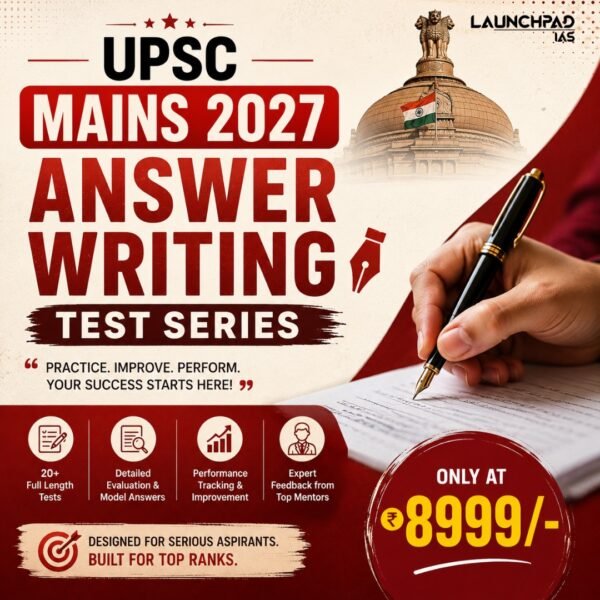
🚀 UPSC MAINS 2027 Answer Writing Test Series
Improve your answer writing skills with a structured test series designed for UPSC Mains 2027 aspirants. Get daily practice, expert evaluation, model answers, personalized feedback, performance tracking, and regular discussion sessions to strengthen your writing and boost your Mains score.
✔ GS Paper I–IV Coverage
✔ PYQs & Expected Questions
✔ Topic-wise & Full-Length Tests
✔ Model Answers & Value Addition
✔ Expert Mentorship & Doubt Sessions
🎯 Target Exam: UPSC Civil Services (Mains) 2027
🏆 Write Better • Think Better • Score Higher
LaunchPad IAS
Your Partner in Civil Services Preparation